
Engineering Visibility: Mitigating LLM Hallucinations for AI Overview Dominance
Visibility in Google's AI Overviews (AIO) is no longer a game of chance or keyword density; it is a rigorous process of Risk Management. In this technical deep dive, we analyze how content precision acts as a "Hallucination-Reducing Layer," securing your position as a primary grounding source in the age of Generative Engine Optimization (GEO).
1. The Grounding Dilemma: Why LLMs Prioritize Deterministic Sources
The fundamental struggle of a Large Language Model (LLM) is the trade-off between creativity (stochastic generation) and accuracy (grounding). When Google's AIO generates a response, it faces the "hallucination penalty." To mitigate this, the system uses Retrieval-Augmented Generation (RAG) to anchor its output in verified external data.
Our R&D at CiteVista suggests that the AIO algorithm doesn't just look for "authority" in the traditional sense (backlinks). It looks for Information Certainty.
The Core Hypothesis: The LLM prioritizes sources that allow it to "ground" its response with the lowest computational entropy. If your content provides a clear, non-ambiguous path for the model to verify its facts, the model "attends" to your data more heavily to de-risk its own output.
2. The Theoretical Framework: Applying the Attention Mechanism to GEO
To truly master GEO, we must look at the mathematical engine behind the citations: the Attention Mechanism from the "Attention Is All You Need" paper (Vaswani et al.).
The formula for scaled dot-product attention is our blueprint for visibility:

In the context of GEO engineering:
- Query (Q): The vectorized representation of the user’s intent (e.g., "Why do I feel butterflies?").
- Key (K): The structural markers and semantic anchors on your page. This is the "index" the AI uses to see if you have the answer.
- Value (V): The actual high-density informational payload that the AI will synthesize into the final overview.
The Engineering Goal: If your Key (K)—your site’s technical scaffolding—perfectly maps to the Query (Q), the Attention Score peaks. Google then trusts your Value (V) enough to display it to the user.
3. Case Study Analysis: "Butterflies in the Stomach"
To test this, we analyzed a high-intent biological query: "why do we feel butterflies in our stomach when we are excited".
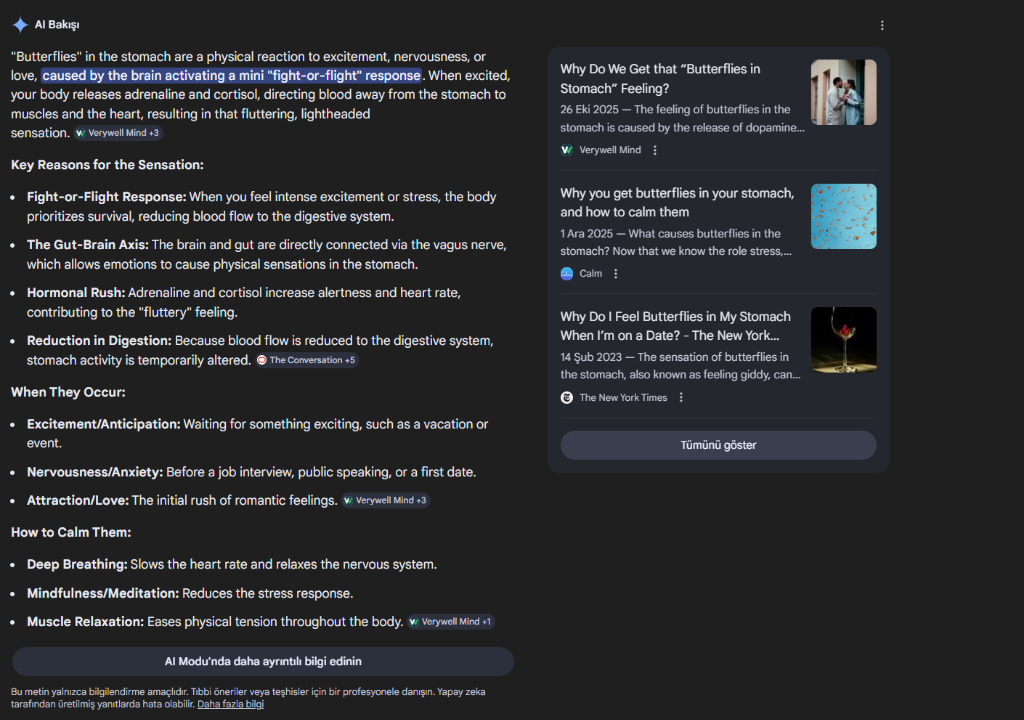
Comparison between a standard high-ranking SEO blog post and the source cited by AIO.
The Failure of Traditional SEO (The "String" Approach)
Most top-ranking pages focus on "Emotional Resonance." They use phrases like "It’s a wonderful feeling of love" or "Many people experience these jitters." While great for human engagement, these are low-certainty strings for an LLM. They provide zero grounding for the biological mechanism.
The Success of GEO (The "Entity" Approach)
The cited source (e.g., Verywell Mind / The Scientist) won because it provided Semantic Triplets that the LLM could use as "Truth Anchors."
Scraped Semantic Triplets found in the winning source:
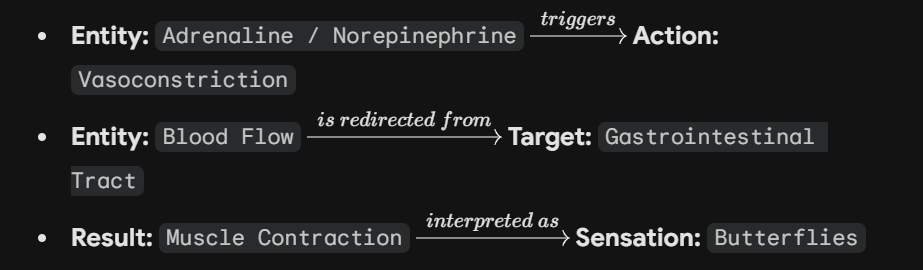
Analysis: The AI didn't cite the page because it was "popular." It cited it because the page provided a deterministic biological map. By explaining the mechanism rather than just describing the feeling, the source reduced the LLM's risk of hallucinating a cause.
4. Engineering the Content: The GEO Visibility Framework
Based on our experimental data, here is how you move from "writing" to "engineering" content:
I. Semantic Scaffolding (H2/H3 Architecture)
Stop using headers for clickbait. Use them as Logic Gates.
- Bad:
## You Won't Believe Why Your Stomach Flutters! - Good:
## The Role of the Sympathetic Nervous System in Gastrointestinal Vasoconstriction
The latter provides a clear Key (K) for the LLM to match against a scientific query.
II. The "Information Gain" Requirement
Google's AIO has no reason to cite you if you only repeat what is in its training data (e.g., Wikipedia). To get cited, you must provide Information Gain:
- Add specific metabolites or neurotransmitters involved.
- Include the "Vagus Nerve" connection or "Gut-Brain Axis" data.
- Provide a unique perspective that the model can use to "verify and expand" its basic knowledge.
III. Triadic Sentence Structure
Every "Grounding Unit" (paragraph) should follow the Entity-Predicate-Object model.
Example: "The [Adrenal Gland] releases [Cortisol] which causes the [Smooth Muscles] to contract."
Why? This structure is easily parsed into a Knowledge Graph, making your site a "Safe Haven" for the RAG process.
Conclusion: From Algorithms to Architectures
SEO used to be about gaming a black-box algorithm. GEO is about feeding a white-box model. By positioning your content as the Hallucination-Reducing Layer of the web, you aren't just ranking; you are becoming part of the AI's internal reasoning process. At CiteVista, we believe that the future of search belongs to those who provide the most "Information Certainty" in an era of generative noise.
If you're working on GEO seriously and want to move from assumption to observation,
explore what CiteVista tracksBerkay Can and Orhan Karcı are the co-founders of CiteVista, a GEO & AEO analytics platform that tracks and measures brand visibility across large language models.