
Brand Perception Analysis — How AI See Your Brand
AI already has an opinion about your brand. This analysis shows you exactly what it is.
The Problem
Every large language model carries an internal representation of your brand — built from training data, web sources, and real-time search results. This representation shapes how AI describes your brand when a user asks about your category, compares competitors, or looks for a solution you offer.
Most brands have no visibility into this. They optimize for Google rankings and assume AI will follow. But LLMs don't rank pages — they build semantic models of entities. And the brand AI positions as the authority in your category is not always the one with the most traffic.
In our own audits, we have repeatedly seen the same pattern: brands with strong organic search presence and well-structured websites receiving zero citations in AI-generated answers for their core product categories — while competitors with weaker SEO footprints were being consistently recommended. The gap wasn't in content volume. It was in how clearly AI could construct a coherent entity representation of the brand.
Brand Perception Analysis gives you direct visibility into how AI models currently understand your brand — what they associate you with, how they describe your market position, and whether their representation aligns with how you actually want to be positioned.
How It Works
Step 1: Select Your AI Model & Data Source
Choose which AI model to analyze — currently Google Gemini, with ChatGPT, Claude, and Perplexity coming soon. Then select your data source:
Live Web Search — the model retrieves real-time information from the web to build your brand's perception profile. This reflects how AI currently interprets your brand based on what it finds when it searches for you today.
Training Data — the model draws on its internal knowledge, built from the data it was trained on. This reveals the baseline perception that exists before any real-time retrieval — what the model "already knows" about your brand.
The distinction matters: a brand may have strong training data presence but weak live web signals, or vice versa. Analyzing both gives you a complete picture of where gaps exist.
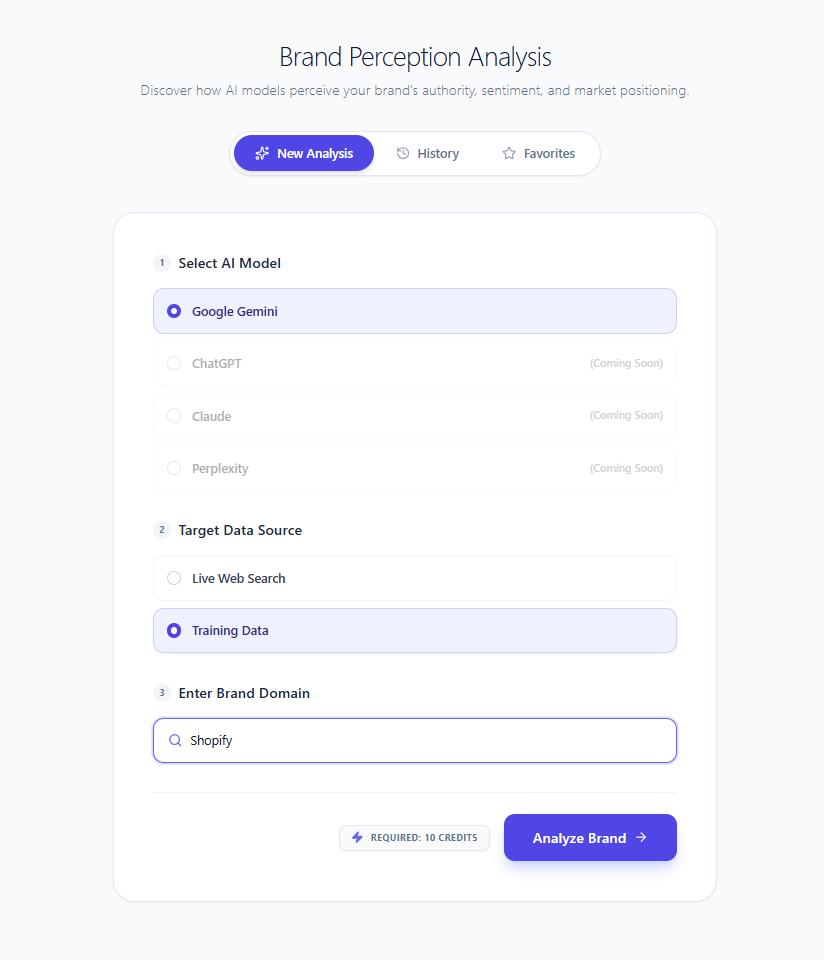 Select AI model and data source — Live Web Search or Training DataSelect AI model and choose between Live Web Search and Training Data
Step 2: Enter Your Brand Domain
Enter the domain of the brand you want to analyze. CiteVista uses this to focus the analysis on your specific brand entity — not a general category or topic.
Step 3: Get Your Results
CiteVista runs the analysis and returns a structured brand perception report with a Confidence Score and four insight layers.
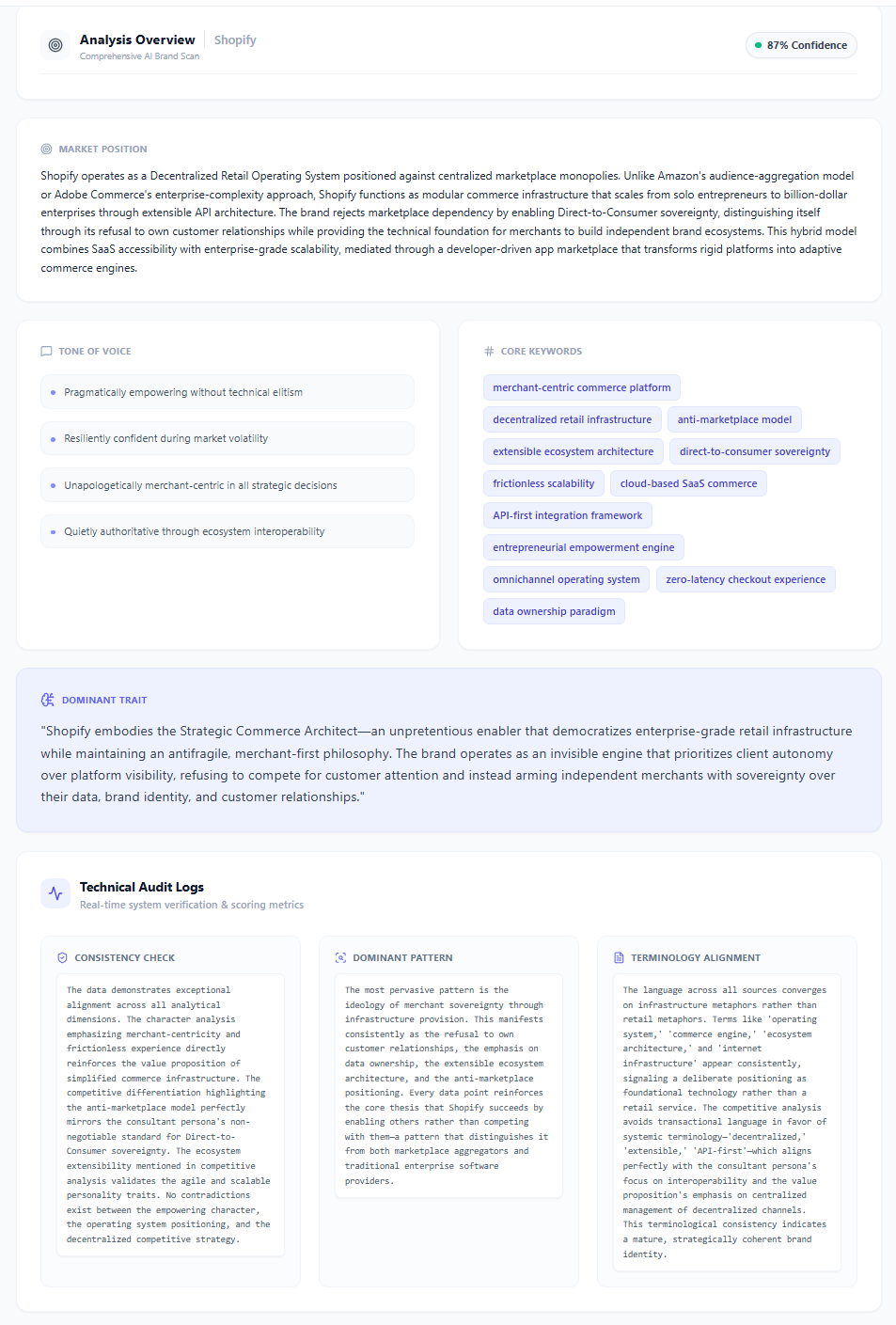 Brand Perception Analysis results — Confidence Score, Market Position, Tone of Voice, Core Keywords, Dominant TraitFull analysis report with Confidence Score and brand intelligence breakdown
What You Get
Confidence Score
Every report is rated from 0 to 100 based on a rigorous triple-audit:
- Data Consistency (40%) — cross-verification across all sources to ensure the insights reflect consistent signals, not outliers
- Technical Specificity (30%) — evaluation of industry-specific terminology and precision in how the model describes your brand
- Strategic Depth (30%) — assessment of the analytical complexity and richness of the model's brand representation
A high confidence score means the model has a strong, consistent, and well-defined internal representation of your brand. A low score signals fragmented or thin entity signals — which is itself an actionable finding.
Market Position
A detailed narrative of how AI currently positions your brand within its competitive landscape — which segment you occupy, how you are differentiated from competitors, and which adjacent brands the model groups you with. This is not a summary of your website. It is how AI semantically processes your brand relative to your category.
Tone of Voice
The dominant communication attributes AI associates with your brand — the voice your brand carries in the model's understanding. This reveals whether AI perceives you as authoritative, accessible, technical, premium, or something else entirely — and whether that perception matches your intended positioning.
Core Keywords
The specific terms and phrases the AI model consistently associates with your brand. These are not keyword rankings — they are the semantic anchors the model uses to represent your brand entity. Gaps between these keywords and your intended positioning are direct inputs for your GEO strategy.
Dominant Trait
A synthesized statement describing the defining characteristic of your brand as AI understands it — the single most coherent identity signal the model has built around your entity.
Technical Audit Logs
Below the main results, the Technical Audit section provides a transparent look into CiteVista's scoring methodology across three dimensions:
Consistency Check — whether the model's brand signals are coherent across character, value proposition, and competitive positioning dimensions, or whether tension exists between different aspects of your brand representation.
Dominant Pattern — the most pervasive narrative thread the model uses to describe your brand, surfacing which story AI tells most consistently when your brand comes up.
Terminology Alignment — how closely the model's language aligns with your actual category terminology, revealing whether AI describes you in the terms your market uses or drifts toward adjacent or competitor language.
Two Data Sources — Two Different Insights
| Live Web Search | Training Data | |
|---|---|---|
| Reflects | Current web presence and recent content | Historical brand signals from training corpus |
| Best for | Tracking perception changes over time | Understanding baseline AI brand identity |
| Affected by | Recent publications, PR, backlinks | Long-term content strategy and entity signals |
Running both gives you the most complete view: where your brand stands in AI's long-term knowledge versus how it is being described based on what exists on the web today.
In practice, we have found that the gap between these two sources is often where the most actionable insights sit. A brand that scores well on Training Data but poorly on Live Web Search has a content freshness or crawlability problem. The reverse — strong live signals but weak training data — typically points to a newer brand that hasn't yet built sufficient entity depth across the web.